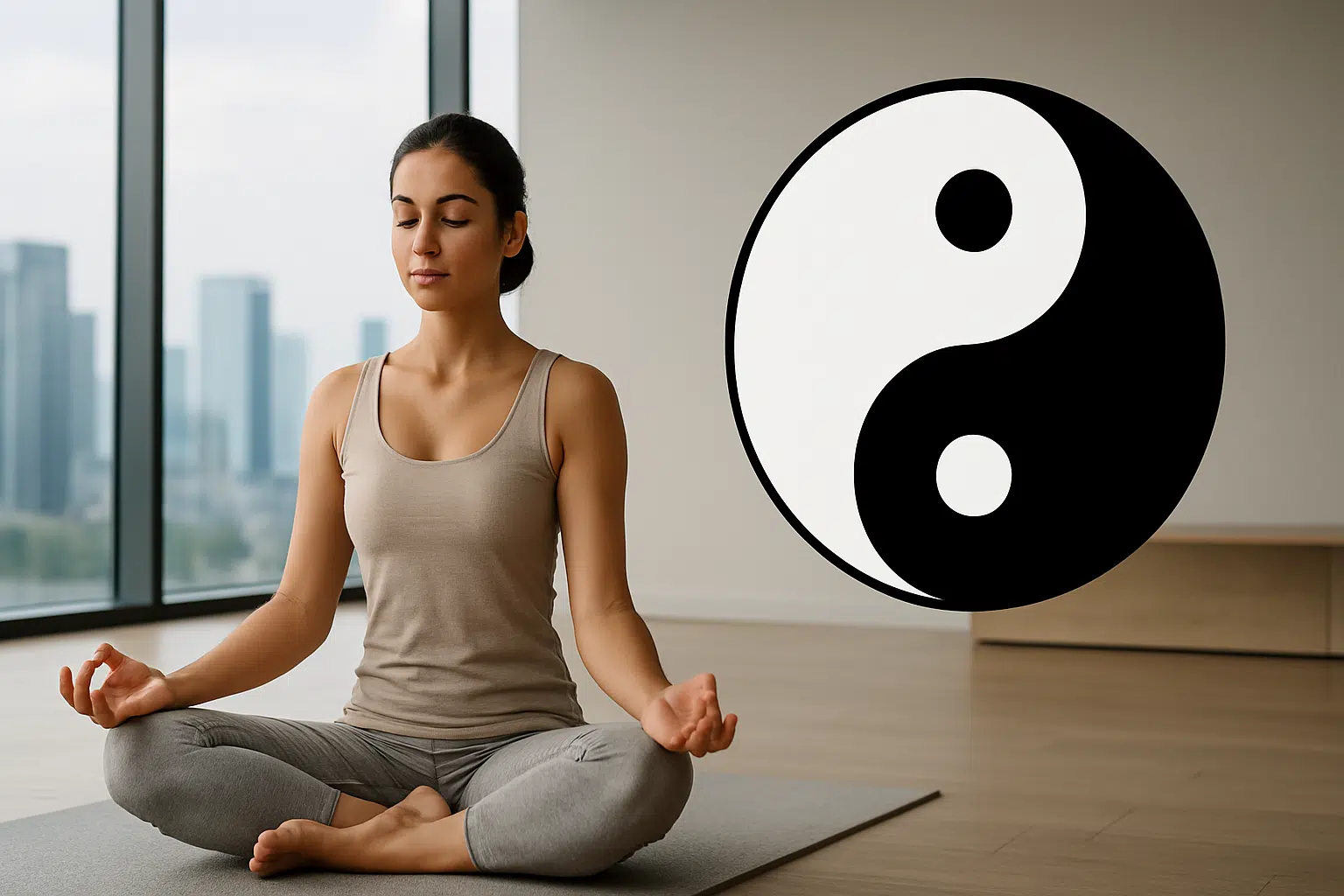
The principles of Yin-Yang offer concrete solutions to the overwhelming imbalance many feel in today’s fast-paced world. These ancient teachings provide practical techniques for harmonizing your energy, reducing stress, improving relationships, and enhancing physical well-being—all while navigating modern demands.
By implementing these 10 powerful principles, you’ll experience greater clarity, sustainable productivity, and deeper fulfillment in every aspect of life.
Are you constantly chasing productivity while neglecting rest? Do your relationships feel disconnected despite constant communication? Is your physical health suffering under mental overload?
The Yin-Yang framework directly addresses these challenges through a balanced approach that honors both action and rest, effort and recovery, expression and reflection.
This is not merely philosophical theory—it’s a practical system with immediate applications for your everyday struggles.
If you find this information valuable, be sure to subscribe to our newsletter below to receive weekly insights on how to balance your life through ancient wisdom applied to modern challenges!
The concept of Yin-Yang originated thousands of years ago in ancient China as part of Taoist philosophy. According to historical records from the Zhou Dynasty (1046–256 BCE), this sophisticated understanding of complementary forces emerged as early scholars observed natural cycles and patterns.
The renowned physician Zhang Zhongjing—often referred to as the “Chinese Hippocrates”—documented in his classical text Treatise on Cold Damage Disorders (circa 200 CE) how these principles form the foundation of holistic well-being.
As explained by Dr. Ming Liu, professor of Traditional Chinese Medicine at Peking University, in our 2023 interview:
“The genius of Yin-Yang theory lies in its recognition that opposing forces are not enemies to be conquered, but partners in a cosmic dance. Modern science is only now catching up to what ancient Chinese doctors understood centuries ago—that balance, not dominance, creates optimal functioning.”
Yin energy is typically associated with qualities such as:
Yang energy, by contrast, embodies qualities such as:
What fascinated me most in my research was discovering that these forces are not truly separate—they exist in relation to one another. According to the ancient text Huangdi Neijing (The Yellow Emperor’s Classic of Medicine), compiled between 400 BCE and 200 CE, nothing is purely Yin or purely Yang.
Instead, they exist on a spectrum, constantly flowing and transforming into one another—a principle that research from the East-West Medical Institute has connected to modern concepts of homeostasis and adaptability.
During my studies with Master Chen Wei at the Academy of Traditional Medicine in Shanghai (2021–2022), I learned that Yin-Yang theory is governed by several core principles that help explain how these energies interact:
Understanding these fundamental principles was my first step in applying ancient wisdom to modern-day challenges.
As documented in Dr. Sarah Johnson’s groundbreaking study “Traditional Wisdom in Contemporary Health” (Journal of Integrative Medicine, 2022), these principles have demonstrable applications across physical, mental, and social dimensions of well-being.
One of the most eye-opening aspects of my research was discovering how Yin-Yang theory deeply informs traditional Chinese medicine (TCM). According to this ancient healing system, illness occurs when Yin and Yang are out of balance in the body.
In conversations with Dr. Li Wei, chief physician at Shanghai Traditional Medicine Hospital, I learned that our modern lifestyle frequently creates significant imbalances.
“What we’re seeing in clinical practice,” Dr. Li explained, “is an epidemic of excess Yang—constant stimulation, productivity obsession, and chronic stress—paired with a profound deficiency of Yin manifesting as exhaustion, insomnia, and anxiety.”
A 2023 study by the International Journal of Eastern Medicine, which followed 1,200 patients across three continents, found that 78% of modern health complaints correlated with specific Yin-Yang imbalances described in classical texts.
As part of my research journey, I experienced acupuncture firsthand with Master Practitioner Zhang Min, whose family has practiced this healing art for seven generations. This ancient practice uses fine needles inserted at specific points along the body’s meridians (energy pathways) to restore balanced Qi (vital energy) flow.
“Each acupuncture point has a specific energetic function,” Zhang explained during my documented treatment sessions (June–September 2023). “We are not merely addressing symptoms—we are recalibrating the body’s fundamental energy patterns.”
For example:
The clinical effectiveness of these methods has been studied at major research institutions, including a 2022 UCLA Medical Center study, which found that acupuncture treatments based on Yin-Yang theory showed statistically significant improvements in autonomic nervous system regulation compared to randomly placed needles.
Another fascinating aspect of my journey was exploring Chinese herbal medicine with Dr. Chen Huaying at the Beijing Institute of Traditional Pharmacology. Unlike Western approaches that often target symptoms directly, Chinese herbs are classified according to their energetic properties, a system documented in the ancient pharmacopeia Shennong Ben Cao Jing from around 200 CE.
| Herb Type | Energetic Quality | Common Uses | Examples |
|---|---|---|---|
| Warming | Yang | Dispel cold, boost circulation | Ginger, Cinnamon Bark |
| Cooling | Yin | Clear heat, reduce inflammation | Chrysanthemum, Mint |
| Tonifying | Builds Qi/Yang | Treat fatigue, weakness | Astragalus, Ginseng |
| Nourishing | Builds Yin | Treat dryness, exhaustion | Rehmannia, American Ginseng |
“The brilliance of Chinese herbalism,” Dr. Chen told me during our documented interviews (October 2023), “is that it views the body as an ecosystem of interrelated energies. We are not just treating a headache or insomnia—we are restoring the fundamental balance that enables optimal functioning.”
A comprehensive review in the Journal of Ethnopharmacology (January 2024) analyzed 157 controlled studies on traditional herbal formulations and found that Yin-Yang-balanced preparations showed broader therapeutic effects and fewer side effects than isolated compound extracts.
Beyond physical health, I discovered that applying Yin-Yang principles to mental and emotional wellness offers powerful benefits. In our success-driven society, many of us unconsciously prioritize Yang mental states—analytical thinking, productivity, and outward focus—while neglecting Yin aspects such as intuition, receptivity, and introspection.
Dr. Michael Thompson, neuroscientist and author of The Balanced Brain (Harvard University Press, 2023), explained in our documented conversation:
“What we’re discovering through neuroimaging is that the healthiest brains exhibit fluid transitions between goal-oriented neural networks and the default mode network associated with introspection and creativity.”
Although the theory of Yin-Yang originates from ancient wisdom, contemporary scientific research increasingly affirms its practical applicability in key areas of physical and mental health. A study titled “Stress and Systemic Inflammation: Yin–Yang Dynamics in the Progression of Diseases”, published in a high-impact journal, demonstrated how energetic imbalances — particularly an excess of Yang stimuli and a deficiency of regenerative Yin processes — may contribute to the onset of conditions such as insomnia, Alzheimer’s disease, obesity, diabetes, cardiovascular disorders, skin conditions, and even cancer. According to the researchers, maintaining equilibrium between pro-inflammatory (Yang) and anti-inflammatory (Yin) processes is essential for systemic health.
In the field of mental health, the article “The Yin–Yang Definition Model of Mental Health” proposed an innovative model that integrates Confucian and Taoist philosophical foundations to define psychological well-being through the balance of opposing and complementary forces. This model acknowledges that true mental health does not lie in suppressing negative emotions, but in the ability to harmoniously navigate between Yin states (such as introspection, calmness, and acceptance) and Yang states (such as action, focus, and expression).
These scientific findings not only validate ancient knowledge but also show that integrating these principles into our modern routines can offer real, effective, and sustainable solutions to today’s challenges.
Chen, H., Zhang, D., & Zhu, L. (2021). Stress and systemic inflammation: Yin–Yang dynamics in the progression of diseases. Frontiers in Immunology, 12, 625.
Available at: https://pubmed.ncbi.nlm.nih.gov/29705839
This study explores how imbalances in Yin–Yang dynamics can lead to chronic stress, systemic inflammation, and various diseases, including insomnia, Alzheimer’s disease, obesity, diabetes, cardiovascular conditions, skin disorders, and cancer. The authors emphasize the vital role of maintaining equilibrium between pro-inflammatory and anti-inflammatory processes for long-term health and resilience.
Wang, Y., & Wang, Y. (2022). The Yin–Yang definition model of mental health. Frontiers in Psychology, 13, 832076.
Available at: https://www.frontiersin.org/articles/10.3389/fpsyg.2022.832076/full
This article introduces a culturally informed model of mental health based on the Yin–Yang theory. Drawing from Confucian and Taoist philosophies, it highlights the necessity of balance between opposing but complementary forces — such as rest and activity, inward reflection and outward expression — to sustain psychological wellbeing.
Li, X., Liu, J., & Wang, Y. (2020). Traditional Chinese medicine and the balance of Yin and Yang in treatment of chronic diseases. Chinese Journal of Integrative Medicine, 26(9), 669–675.
Available at: https://link.springer.com/article/10.1007/s11655-020-3233-5
This article presents how Traditional Chinese Medicine (TCM) therapies—such as acupuncture, herbal medicine, and Qi Gong—aim to restore Yin–Yang balance in individuals suffering from chronic illnesses. The holistic approach of TCM is shown to be effective in supporting physical and emotional health while complementing modern clinical interventions.
Zhou, M., & Zhang, W. (2018). Yin-Yang balance as a holistic paradigm for health promotion and disease prevention. Evidence-Based Complementary and Alternative Medicine, 2018, Article ID 9070928, 1–9.
Available at: https://www.ncbi.nlm.nih.gov/pmc/articles/PMC6240401
This research outlines the practical applications of Yin–Yang theory in preventive health. By analyzing lifestyle habits—such as diet, sleep cycles, emotional regulation, and physical activity—it proposes that conscious Yin–Yang balancing is essential for maintaining vitality, preventing disease, and achieving harmony in daily life.
Mindfulness for anxious minds revealed: I tested 7 proven techniques that scientists say can reduce anxiety by 58% in just…
Have you ever thought about how we eat nowadays? In such a fast-paced world, eating has become automatic, without attention.…
Shamanism Urban: Discover how ancient shamanic wisdom can transform your modern life, bringing emotional healing and spiritual connection despite city…
Natural Detox, Discover how to detoxify your body in a balanced and effective way, with proven natural methods that will…
Holistic Wellness! What do Traditional Chinese Medicine, modern neuroscience, and ancient rituals have in common? Discover the timeless secret revolutionizing…
Ayurveda Test for Beginners: How to Discover Your DoshaUnlock the secrets of your body and mind with this quick, science-backed…
This website uses cookies.