

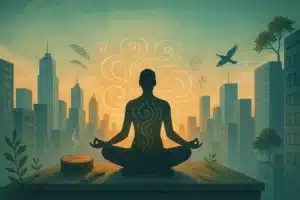
Shamanism Urban: Discover how ancient shamanic wisdom can transform your modern life, bringing emotional healing and spiritual connection despite city chaos. My journey reveals powerful yet accessible practices anyone can use.
Hidden Wisdom in the Concrete Jungle
When I first encountered the concept of urban shamanism, I was skeptical. Shamans in the city? Ancient healing practices coexisting with smartphones and skyscrapers? It seemed contradictory. But as I delved deeper into this fascinating topic, I discovered something remarkable: The ancient wisdom of shamanic traditions is not only relevant to our modern world—it may be exactly what we need to restore balance to our chaotic lives.
Urban shamanism, the adaptation of ancient spiritual practices to today’s urban environments, offers powerful tools for emotional healing, stress management, and reconnecting with nature despite the concrete surroundings. These practices help us navigate the unique challenges of modern life while honoring the ancestral wisdom that has guided people for thousands of years.
Let me share what I’ve learned in my journey exploring how these ancient practices are being reimagined for our modern world, and how you can incorporate them into your daily life, regardless of where you live.
What Exactly Is Urban Shamanism?
Urban shamanism takes traditional shamanic practices—developed by indigenous cultures worldwide over thousands of years—and adapts them to our contemporary urban settings. Traditional shamanism centers around a practitioner (the shaman) who accesses altered states of consciousness to interact with the spirit world for healing, divination, and community guidance.
In the urban context, these practices are modified to work within city environments, focusing particularly on:
- Finding connection to nature within urban settings
- Managing the unique emotional and spiritual challenges of modern life
- Creating sacred space in homes and offices
- Using shamanic techniques for stress relief and emotional healing
- Building community in fragmented urban environments
Unlike some spiritual practices that require complete lifestyle changes, urban shamanism recognizes that most people can’t abandon their responsibilities to live in nature. Instead, it offers practical ways to bring ancestral wisdom into everyday modern life.

The Growing Need for Emotional Balance in Modern Life
Why is urban shamanism gaining popularity now? The answer lies in our collective emotional state. Research from the World Health Organization shows anxiety and depression have increased by over 25% worldwide since the COVID-19 pandemic. We’re more technologically connected yet emotionally isolated than ever before.
The constant stimulation, information overload, and disconnection from natural cycles create what shamanic practitioners call “soul loss”—a state where we feel fragmented, exhausted, and separated from our authentic selves and the natural world.
Urban shamanism addresses these specific modern challenges by offering:
- Techniques to create boundaries with technology
- Practices for grounding amid constant stimulation
- Methods to reconnect with natural cycles even in artificial environments
- Community-building rituals that counter isolation
- Simple daily practices that restore emotional balance
Core Practices of Urban Shamanism
Through my research and personal experiments, I’ve identified several fundamental practices that form the foundation of urban shamanism. These are accessible entry points for anyone curious about incorporating these ancient techniques into modern life.
Creating Sacred Space in Urban Environments
Traditional shamans work in specially designated sacred spaces. In urban settings, we need to create these spaces within our homes and workplaces:
- Altar Creation: Even a small corner of a room can become a personal altar with objects that connect you to nature (stones, plants), personal power (meaningful objects), and your intentions.
- Energetic Cleansing: Using sound (bells, singing bowls), smoke (sage, palo santo), or visualization to clear stagnant energy from living spaces.
- Threshold Rituals: Creating simple rituals for entering and leaving your home that help separate your sacred space from the outside world.
One practitioner I interviewed, Maya, transformed her tiny studio apartment in Chicago by designating her windowsill as a nature altar with plants, stones from parks, and a bowl of water. “It’s my miniature piece of the natural world,” she told me. “When I sit before it each morning, even for five minutes, I feel like I’ve stepped outside the city.”
Reconnecting with Nature in Urban Settings
Finding connection to the natural world is essential in shamanic practice, even in cities:
- Plant Relationships: Developing relationships with house plants, park trees, or even “weeds” growing through sidewalk cracks.
- Urban Wildlife Observation: Paying attention to birds, insects, and other urban wildlife as messengers and teachers.
- Sky Watching: Taking time to observe the moon phases, star patterns, and weather changes to reconnect with natural cycles.
- Urban Foraging: Learning about edible plants in urban environments (with proper safety knowledge).
James, an urban shaman practicing in London, leads “concrete jungle walks” where participants notice signs of nature’s persistence in the city. “When you realize nature is still here, finding its way through cracks in the pavement, it changes your relationship with the city,” he explains.
Shamanic Journey Work Adapted for Modern Life
The shamanic journey—entering an altered state to gain insight and healing—remains central to urban shamanism:
- Guided Visualization: Using recorded guidance or written instructions for visualized journeys.
- Sound-Induced Trance: Using drumming, rattling, or specially designed audio tracks to induce light trance states.
- Dream Work: Paying attention to dreams as journeys and learning techniques to incubate specific dream guidance.
- Movement Practices: Using simple repetitive movements (walking, dancing, rocking) combined with intention to access altered awareness.
Sarah, who practices urban shamanism in Tokyo, uses her morning subway commute for journey work. “With noise-canceling headphones and a drumming track, I journey while sitting on the train. No one around me has any idea,” she shared. “I arrive at work energized and centered.”
Emotional Healing Techniques from Shamanic Traditions
Urban shamanic practices offer specific tools for emotional healing that are particularly relevant to modern challenges:
Energy Body Maintenance
Shamanic traditions worldwide recognize an energy body that requires regular maintenance:
- Aura Cleansing: Visualization techniques to clear negative energy from your personal field.
- Chakra Balancing: Working with the traditional energy centers through visualization, sound, or movement.
- Cord Cutting: Visualizing and releasing unhealthy energetic connections to people, places, or situations.

Soul Retrieval Adaptations
Traditional shamans perform soul retrieval to recover fragmented aspects of a person’s essence. Urban adaptations include:
- Memory Healing: Revisiting difficult memories with new perspective and compassion.
- Inner Child Work: Reconnecting with and healing aspects of yourself from different life stages.
- Parts Dialogue: Communicating with different aspects of yourself through journaling or visualization.
Carlos, an urban shamanic practitioner in Mexico City, explains: “In traditional communities, soul loss might happen from trauma like accidents or loss. In cities, we experience micro-traumas daily—from negative news consumption to social media comparison to workplace stress. Modern soul retrieval addresses these contemporary causes.”
Community Ritual in Fragmented Times
Traditional shamanism always existed within community contexts. Urban adaptations include:
- Virtual Circles: Online communities and ceremonies that connect practitioners across distances.
- Urban Ritual Groups: Small gatherings in homes, parks, or rented spaces for shared practice.
- Individual Rituals with Collective Intention: Coordinated practices performed individually but with shared purpose.
Daily Urban Shamanic Practices for Beginners
From my research and conversations with practitioners, these simple daily practices offer entry points for incorporating urban shamanism into your life:
- Morning Greeting: Take 2 minutes upon waking to acknowledge the elements (earth beneath your building, air you breathe, water in your pipes, fire/electricity powering your home).
- Threshold Awareness: Create a simple gesture or word to mark transitions between spaces (home to outside, work to home).
- Lunch Contact: Touch a plant, tree, or earth during your lunch break, even briefly.
- Evening Release: Before sleep, visualize releasing the day’s stress into a natural element (flowing water is particularly effective).
- Weekly Nature Connection: Dedicate even 30 minutes weekly to direct contact with the most natural setting available to you.
Jane, who began practicing urban shamanism during her high-stress finance career, shared: “Starting with just the morning greeting ritual changed everything. That two minutes of connection before checking my phone gave me a completely different foundation for the day.”
Scientific Perspectives on Shamanic Practices
While maintaining respect for the spiritual dimensions of shamanic practice, research suggests neurological and psychological benefits to many shamanic techniques:
- Rhythmic drumming induces theta brain wave states similar to deep meditation
- Ritual creates psychological containers for processing difficult emotions
- Connection to nature reduces cortisol levels and improves mood
- Community ceremonies satisfy fundamental human needs for belonging
- Altered states of consciousness can increase neuroplasticity
Dr. Michael Harner’s research through the Foundation for Shamanic Studies has documented physiological changes during shamanic journeying that resemble both deep relaxation and heightened awareness states.
Ethical Considerations in Urban Shamanism
Throughout my exploration of urban shamanism, ethical questions have been paramount:
Cultural Appropriation vs. Respectful Adaptation

Urban shamanism walks a delicate line between honoring indigenous wisdom and appropriating it. Ethical practitioners:
- Acknowledge the origins of practices they use
- Support indigenous teachers and causes
- Avoid commodifying sacred practices
- Adapt principles rather than copying specific ceremonies
- Recognize the different context of urban practice
Finding Authentic Teachers
With increasing interest in shamanic practices, distinguishing authentic teachers requires discernment:
- Look for teachers who acknowledge their own teachers and lineage
- Beware of those making grandiose claims or charging excessive fees
- Seek those who emphasize personal responsibility and empowerment
- Value teachers who respect both traditional wisdom and modern contexts
Robert, who teaches urban shamanic practices in Sydney, emphasizes: “I’m clear about what I’ve learned from indigenous teachers, what comes from my own practice, and what’s been adapted. Transparency about sources is essential.”
Creating Your Urban Shamanic Practice
Based on my research, here’s how you might begin developing your own urban shamanic practice:
- Start with observation: Before any formal practice, simply notice natural elements in your urban environment—the movement of air, birds, seasonal changes.
- Create a minimal sacred space: Designate even a small area in your home with objects representing nature and personal meaning.
- Begin with brief daily practices: Choose one simple practice to perform daily for at least 30 days before adding more.
- Find community: Look for local groups, online forums, or even one other person interested in exploring these practices.
- Keep a journal: Document your experiences, questions, and insights as your practice develops.
- Respect your intuition: Notice which practices resonate and which don’t, adapting accordingly.
Conclusion: Ancient Wisdom for Modern Survival
Urban shamanism offers more than just techniques for stress relief—it provides a framework for finding meaning, connection, and balance in our complex modern world. As I’ve discovered through this journey, these practices don’t require rejecting technology or modern life but rather creating a healthier relationship with them.
The wisdom of indigenous traditions reminds us that humans have always faced challenges requiring adaptation and resilience. The tools that helped our ancestors navigate their changing worlds may be exactly what we need to thrive in ours.
Whether you’re dealing with anxiety, seeking deeper connection, or simply curious about integrating ancient wisdom into contemporary life, urban shamanic practices offer accessible entry points. The concrete jungle, with all its challenges, can also be a place of profound healing and transformation when approached with shamanic awareness.
As one elder told me, “The spirits are everywhere—not just in forests and mountains. They’re in the subway tunnels, city parks, and even in the wires that connect us. The question is: are we paying attention?”
I invite you to pay attention in new ways as you move through your urban environment. The ancient wisdom is waiting, hiding in plain sight amidst the skyscrapers and streetlights, ready to help you find balance in our extraordinary modern world.
References and Further Reading
- Harner, M. (2013). Cave and Cosmos: Shamanic Encounters with Another Reality. North Atlantic Books.
- Ingerman, S. (2008). Shamanic Journeying: A Beginner’s Guide. Sounds True.
- Cowan, T. (1996). Shamanism as a Spiritual Practice for Daily Life. Crossing Press.
- Foundation for Shamanic Studies Research Publications. www.shamanism.org
- Journal of Transpersonal Psychology, multiple articles on shamanic states and practices
- Williams, D. (2017). Urban Shamanism: Finding Nature Connection in Concrete Landscapes. Green Press.