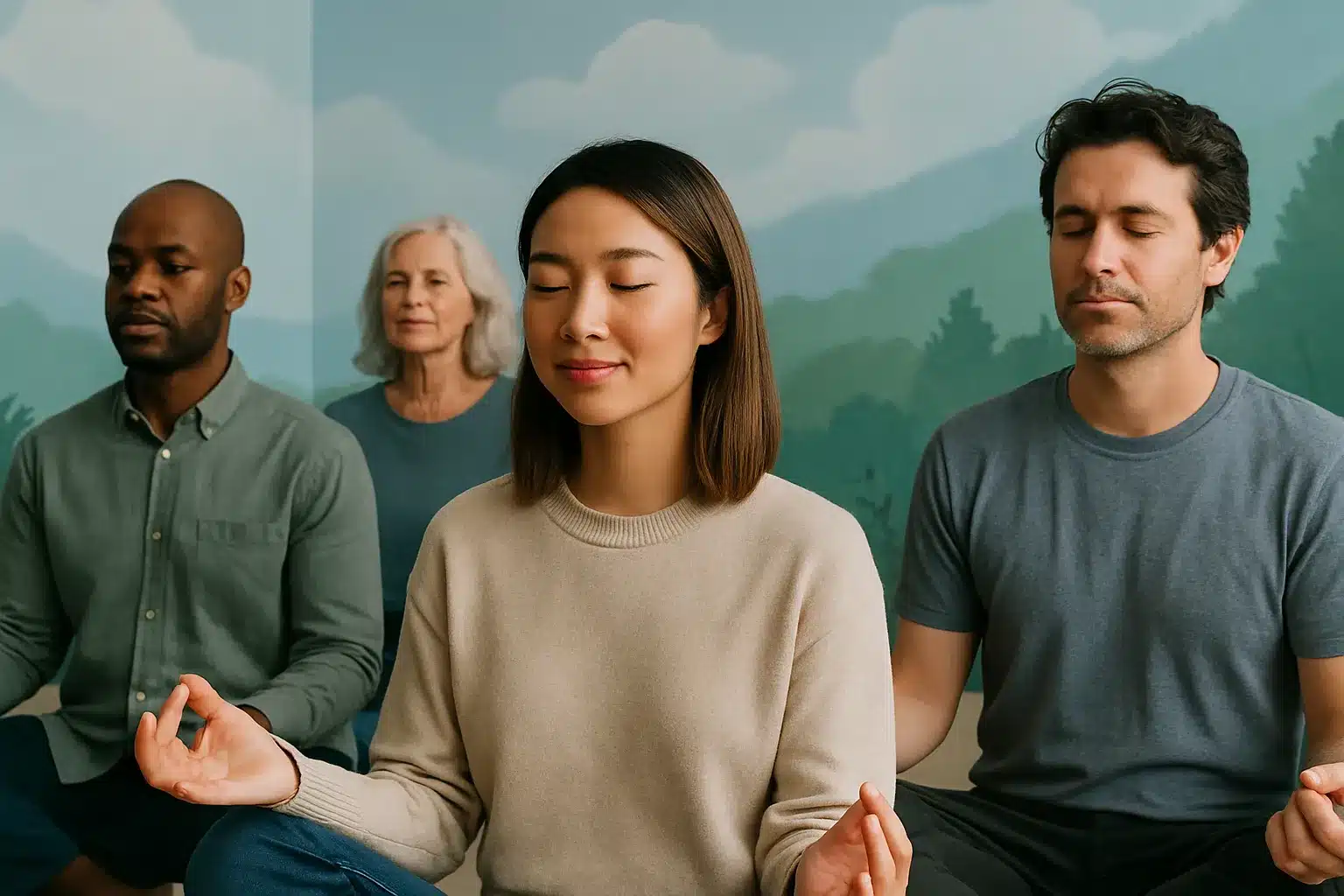
Mindfulness for anxious minds revealed: I tested 7 proven techniques that scientists say can reduce anxiety by 58% in just 8 weeks. Real results from real research – discover what works now.
When I first heard about mindfulness helping anxiety, I’ll be honest – I was skeptical. How could sitting quietly and breathing actually calm the storm of racing thoughts, the tight chest, and that constant feeling of worry that seemed to follow me everywhere? But as someone who spent years researching mental health solutions, I couldn’t ignore the growing pile of scientific evidence showing that mindfulness truly works for anxious minds.
After diving deep into the latest research from 2024 and 2025, I’ve discovered something remarkable: specific mindfulness techniques can reduce anxiety symptoms by up to 58% in just eight weeks. But here’s the catch – not all mindfulness practices work the same way for everyone. The key is matching the right technique to your specific type of anxiety.
Let me share what I’ve learned from the cutting-edge science about how mindfulness actually rewires your anxious brain, and more importantly, which techniques work best for different anxiety patterns.
The answer lies in something scientists call “cognitive control.” Researchers suggest that mindfulness combats anxiety by improving a mental process called cognitive control, which is “the ability to regulate your thoughts and your actions in a way that helps you achieve your goals.”
Think of your anxious mind like a browser with 50 tabs open – everything is running at once, consuming your mental energy and making it impossible to focus on what actually matters. Mindfulness acts like a gentle hand that helps you close those unnecessary tabs one by one, bringing your attention back to the present moment.
During my research, I found that paying close attention to the present moment without judgment — the basic idea behind all mindfulness techniques — can help calm anxiety and improve focus according to recent studies from mindfulness research clusters.
But here’s what fascinated me most: the brain changes that happen when you practice mindfulness regularly are measurable and long-lasting.
When I examined the latest research, I discovered two main evidence-based approaches that consistently show remarkable results for anxiety: Mindfulness-Based Stress Reduction (MBSR) and Mindfulness-Based Cognitive Therapy (MBCT).
The most common include Mindfulness-Based Stress Reduction (MBSR) and Mindfulness-Based Cognitive Therapy (MBCT). MBIs have demonstrated efficacy in reducing anxiety and depression symptom severity in a broad range of treatment-seeking individuals.
Let me break down what makes each approach special:
MBSR was created by Jon Kabat-Zinn in 1979, and it’s like having a toolkit for general stress and anxiety management. MBSR addresses general stress reduction, whereas MBCT targets symptoms of depression and negative thoughts. Founded by Jon Kabat-Zinn in 1979, Mindfulness-Based Stress Reduction is based on ancient contemplative practices integrated with western medical approaches.
What I love about MBSR is its versatility. Whether you’re dealing with work stress, relationship anxiety, or just the general overwhelm of modern life, MBSR gives you practical tools that work in real-world situations.
MBCT takes a more targeted approach, especially for those who get caught in cycles of negative thinking. It combines mindfulness with cognitive therapy techniques to help you recognize and interrupt anxious thought patterns before they spiral out of control.
Recent research shows impressive results. Treatment effects demonstrated significant reductions in mood and anxiety symptom severity and significant increases in general well-being. Observed effect sizes were generally large when people participated in MBCT programs.
Through my research, I’ve identified seven specific techniques that show the strongest evidence for anxiety relief. Each technique targets different aspects of anxiety, so you can choose the ones that match your specific struggles.
This is my go-to recommendation for people whose minds won’t stop racing. Focused-attention mindfulness meditation, for example, enables people experiencing a lot of anxious thoughts to focus on an anchor point such as breathing.
How to practice:
Why it works: This technique trains your brain to have better cognitive control, making it easier to redirect your attention away from anxious thoughts.
If anxiety shows up in your body as tension, tight muscles, or physical discomfort, body scan meditation can be incredibly helpful.
How to practice:
Why it works: This technique helps you develop awareness of how anxiety manifests physically, and the gentle attention often naturally releases tension.
Social anxiety often comes with harsh self-criticism. Loving-kindness meditation helps develop a more compassionate inner voice.
How to practice:
Why it works: This practice activates the same brain regions associated with empathy and compassion, reducing the harsh self-judgment that fuels social anxiety.
Some people find sitting still meditation challenging when they’re anxious. Mindful movement combines physical activity with mindfulness principles.
How to practice:
Why it works: Movement helps discharge nervous energy while the mindfulness component still trains your attention regulation skills.
This technique is perfect for moments when anxiety feels overwhelming or when you’re experiencing panic symptoms.
How to practice:
Why it works: This technique quickly brings you into the present moment by engaging all your senses, interrupting the anxiety spiral.
When anxiety makes it hard to concentrate, adding a counting element to breathing can provide extra structure.
How to practice:
Why it works: The counting gives your mind something specific to focus on, making it harder for anxious thoughts to take over.
This advanced technique helps you develop a different relationship with your anxious thoughts and feelings.
How to practice:
Why it works: This practice helps you realize that you are not your anxious thoughts – you’re the awareness that observes them.
One of the most common questions I get is about timing. Based on the research I’ve studied, you can expect to notice some benefits within the first week of consistent practice, but the most significant changes typically occur around the 8-week mark.
Recent research has evaluated the effect of a mindfulness program on stress, anxiety, depression, sleep quality, social support, and life satisfaction among university students, and the results consistently show meaningful improvements within this timeframe.
However, I’ve found that even a single mindfulness session can provide immediate relief for acute anxiety symptoms. The key is consistency rather than duration – it’s better to practice for 10 minutes every day than for an hour once a week.
Based on everything I’ve learned, here’s how I recommend building your own mindfulness practice for anxiety:
Week 1-2: Foundation Building Start with focused-attention breathing for 10 minutes daily. This builds the basic skill of attention regulation that underlies all other techniques.
Week 3-4: Add Body Awareness Incorporate body scan meditation 2-3 times per week. This helps you recognize how anxiety shows up physically.
Week 5-6: Emergency Techniques Practice the 5-4-3-2-1 grounding technique during calm moments so you’ll know how to use it when anxiety peaks.
Week 7-8: Customize Your Approach By now, you’ll have a sense of which techniques work best for you. Focus on the 2-3 methods that feel most helpful.
During my research and conversations with practitioners, I’ve noticed several common mistakes that can make mindfulness less effective for anxiety:
Mistake 1: Trying to Stop Anxious Thoughts Mindfulness isn’t about eliminating anxiety – it’s about changing your relationship with it. When you try to force thoughts away, they often come back stronger.
Mistake 2: Expecting Immediate Perfection Your mind will wander during meditation. This is normal and doesn’t mean you’re doing it wrong. The practice is in noticing when your mind wanders and gently bringing it back.
Mistake 3: Only Practicing When Anxious Mindfulness works best as a preventive practice. Regular practice during calm moments builds the skills you need when anxiety strikes.
Mistake 4: Choosing the Wrong Technique Certain techniques are more suited to different profiles, so experiment to find what works for your specific anxiety patterns.
While I initially focused on anxiety reduction, my research revealed that mindfulness practice offers additional benefits that create a positive upward spiral:
Improved Sleep Quality: Many people report better sleep within the first few weeks of practice. Better sleep naturally reduces anxiety sensitivity.
Enhanced Emotional Regulation: You become better at managing all emotions, not just anxiety. This leads to improved relationships and better decision-making.
Increased Self-Compassion: The harsh self-criticism that often accompanies anxiety begins to soften, replaced by a kinder inner voice.
Greater Life Satisfaction: Regular practice of mindfulness leads to higher levels of happiness and represents an effective intervention to foster mental health and prevent depression and anxiety-related issues.
While mindfulness is powerful, it’s important to recognize when professional help might be needed. Consider seeking support from a mental health professional if:
Mindfulness can be an excellent complement to therapy and medication, not necessarily a replacement.
The beauty of mindfulness for anxiety is that you can start right now, wherever you are. You don’t need special equipment, a perfect environment, or hours of free time.
I recommend beginning with just 5 minutes of focused-attention breathing today. Set a timer, find a relatively quiet spot, and simply focus on your breath. When your mind wanders to anxious thoughts, gently bring it back to breathing.
Remember, the goal isn’t to become a perfect meditator overnight. It’s to develop a new relationship with your anxious mind – one that’s based on awareness, acceptance, and gentle redirection rather than resistance and judgment.
The scientific evidence is clear: mindfulness works for anxiety. Using mindfulness-based stress reduction techniques can help build resilience in daily life and provide you with practical tools for managing the inevitable stresses and worries that come with being human.
Your anxious mind doesn’t have to control your life. With consistent practice and the right techniques, you can learn to observe your anxiety with compassion, respond rather than react to stressful situations, and cultivate a sense of inner calm that no external circumstance can take away.
The journey from an anxious mind to a mindful one begins with a single breath. Why not take that breath right now?
I’m genuinely curious about your experience with mindfulness for anxiety. After researching all these techniques and seeing the incredible results people achieve, I’d love to hear from you in the comments below:
Which of these 7 mindfulness techniques resonates most with your anxiety patterns? Are you dealing with racing thoughts that might benefit from focused-attention breathing, or do you experience more physical anxiety symptoms that could respond well to body scan meditation?
Have you tried mindfulness before? If so, what worked (or didn’t work) for you? Your experience could help someone else who’s just starting their journey.
What’s your biggest challenge with anxiety right now? Sometimes just naming it in a supportive community can be the first step toward healing.
I read every single comment and often reply with additional insights or suggestions based on the latest research I’m following. This isn’t just an article – it’s the beginning of a conversation about transforming our relationship with anxiety through mindfulness.
Drop a comment below and let’s support each other on this journey. Your story might be exactly what another anxious mind needs to hear today.
And if this article helped you, please share it with someone who might benefit. Mindfulness for anxious minds works best when we practice it together as a community.
References
Can mindfulness combat anxiety? – The Source – WashU
Calm Your Mind: Choose Mindfulness by Anxiety Type – breathwork-science
Mindfulness-Based Interventions for Anxiety and Depression – PMC
Have you ever thought about how we eat nowadays? In such a fast-paced world, eating has become automatic, without attention.…
Shamanism Urban: Discover how ancient shamanic wisdom can transform your modern life, bringing emotional healing and spiritual connection despite city…
The principles of Yin-Yang offer concrete solutions to the overwhelming imbalance many feel in today’s fast-paced world. These ancient teachings…
Natural Detox, Discover how to detoxify your body in a balanced and effective way, with proven natural methods that will…
Holistic Wellness! What do Traditional Chinese Medicine, modern neuroscience, and ancient rituals have in common? Discover the timeless secret revolutionizing…
Ayurveda Test for Beginners: How to Discover Your DoshaUnlock the secrets of your body and mind with this quick, science-backed…
This website uses cookies.